Programme pédagogique
En effet la basse-continue est, et a toujours été une partie primordiale de la vie quotidienne du claveciniste. Négliger la basse-continue, ce serait par conséquent s’enfermer dans la tour d’ivoire d’un rapport à la musique solitaire et anachronique, et risquer par là de n’être qu’un assez mauvais interprète, faute d’avoir expérimenté le rapport à la musique des auteurs que nous admirons.
The basso continuo unveils a captivating role of keyboard instruments, serving to organize a framework for all musical elements. Not only does it structure rhythmic and harmonic foundations upon which musical rhetoric and accents unfold, but it also shapes the auditory space in which affects and colors can flourish. This is achieved by manifesting a sonic spectrum determined by the qualities of keyboard tuning. The basso continuo plays a crucial role in establishing the fundamentals (fondamento) of music: time and sound. It embodies a characteristic feature of the Baroque era, rooted in the robust organization of clear, hierarchical structures.
Once basso continuo practice was refined and standardized, it emerged as the fundamental substance through which musicians could master the language of music. Even today, it remains evident that playing the basso continuo encompasses all the essential components of a well-rounded musical education. It involves reading and inventing notes, exploring repertoire, understanding harmony and melodic invention, and delving into compositional techniques. Through this process, one acquires indispensable familiarity with the formulas and nuances that constitute the foundational material of musical art, spanning from the seventeenth to at least the mid-nineteenth centuries. For a performing musician, there is arguably nothing more crucial than cultivating a composer's intelligence and truly understanding the essence of what they are playing. This objective aligns with the goals of various historically informed musical movements.
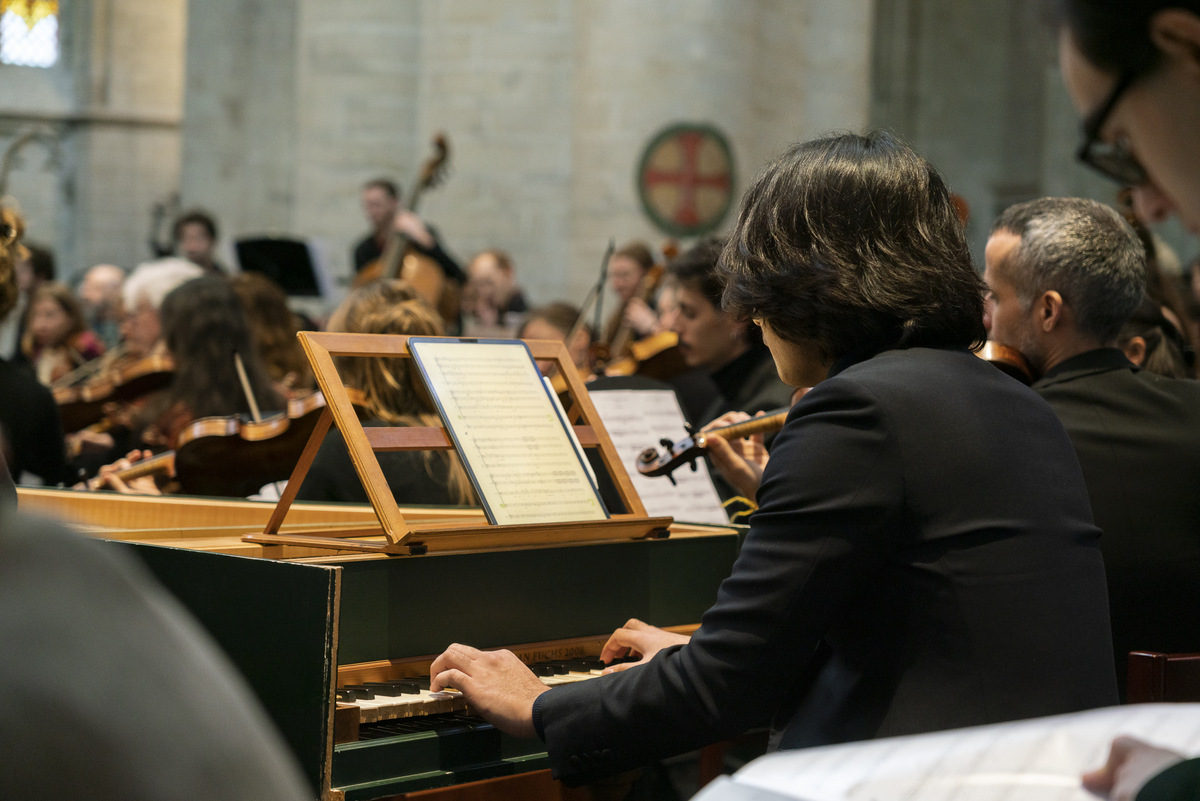
However, there is a lot of speculation about the basso-continue. We try to reconstruct a practice, and nothing is more difficult. All too often, the question of how to do it is asked, obliterating the all-important question of why to do it. The problem of the basso continuo is twofold: theoretical and practical. It covers a dual competence, artistic and academic, a dual function, musical and pedagogical. Things are similar to what happens when studying a foreign language. For months and years, you do grammar exercises, you learn vocabulary lists, you engage in more or less controlled practice. And then you have to travel, you have to go to faraway countries, you have to take to the streets. Then another reality appears, in all its splendour - or in all its abomination. Some of the best students don't dare open their mouths and don't understand a word. A few dunces, clever as monkeys, guided by a mysterious instinct, manage. A certain confidence, a certain smile and a certain flexibility are essential.
Confident in the thorough preparation undertaken by our harpsichordists across their four regular voices, my aim is to enhance the quality of their ensemble playing. This involves fostering flexibility and achieving the closest possible integration with a group of musicians. The focus is on clarifying their role—how they can adhere closely to textures, respond to nuances in dynamics and emotions, and provide robust support without overshadowing or disrupting the ensemble. Balancing the precision of the harpsichord with the freedom required for complicity, enabling Baroque rhetoric to unfold with its essential unpredictability, demands substantial and enlightened practice. The Early Music Department at the Royal Conservatory of Brussels offers an abundance of situations crucial for effective training in this regard.

 English (UK)
  Français